

The Inflection Point in Canadian Banking
Canada’s Consumer-Driven Banking Framework has entered its critical operational phase. With the Financial Consumer Agency of Canada (FCAC) establishing regulatory oversight and standardizing data exchange rules, financial institution leaders can no longer relegate open banking to an exploratory IT committee.
For years, Canadian banks and credit unions looked across the Atlantic at the UK’s CMA9 mandate and saw a cautionary tale: financial institutions spending tens of millions on compliance with negligible new revenue to show for it.
However, the North American landscape in 2026 is fundamentally different. Forward-thinking Canadian institutions are recognizing that Open Banking is not an IT cost center—it is an enterprise distribution strategy.
3 Core Strategic Pillars for Bank Leadership
1. Shift from Defensive Compliance to Offensive Product Development
Traditional compliance planning asks: “What is the minimum API capability required to satisfy the FCAC mandate?”
Winning leadership teams ask: “How can we utilize bidirectional open APIs to attract prime commercial borrowers, automate SMB bookkeeping reconciliations, and ingest primary retail deposits from competitors?”
Key immediate opportunities include:
- Instant Account Verification (IAV) for pre-approved lending and automated credit lines.
- Embedded Cash Flow Forecasting integrated directly inside the business online banking portal.
- Multi-Bank Balance Aggregation that gives business owners a unified dashboard while positioning your institution as their primary treasury hub.
2. Modernize the Middleware Layer (Without Replacing Your Core)
The primary roadblock cited by tier-2 and tier-3 financial institutions is legacy core banking architecture. Upgrading a core system requires 3–5 years, millions in capital expenditure, and massive operational risk.
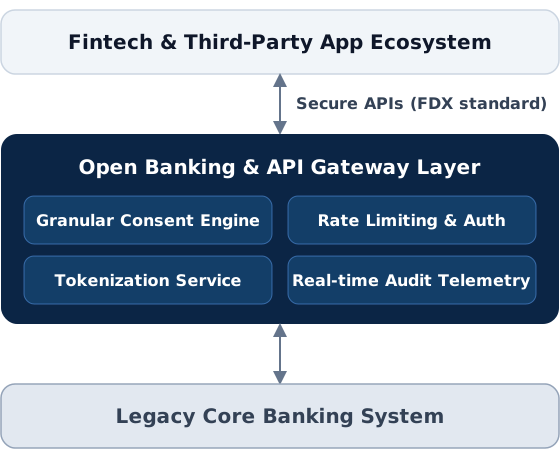
The pragmatic solution is API virtualization and headless middleware layering:
- Deploying standardized API gateways (aligned with FDX / Canadian standards) that sit on top of legacy core databases.
- Isolating transactional read/write operations from batch-oriented legacy mainframes.
- Implementing zero-trust tokenization and granular customer consent registries.
3. Establish Commercial Monetization Models Early
While baseline consumer account data access will be free under mandated open banking rules, premium value-added APIs represent an enormous greenfield revenue opportunity:
- Instant Payment Initiation (RTR): Charging fractional transaction fees for guaranteed, real-time merchant settlement.
- Enriched Identity & Income Verification: Monetizing real-time payroll and financial health scoring for external mortgage brokers and auto lenders.
- Commercial ERP Data Feeds: Charging enterprise clients for direct, automated two-way feeds into SAP, NetSuite, and QuickBooks.
Executive Action Checklist for Q3/Q4
- Conduct an Open Banking Readiness Audit: Assess current API capabilities, latency, and data format compliance against FDX benchmarks.
- Review Consent & Privacy Frameworks: Align internal data retention and security governance with evolving FCAC guidelines.
- Map the Top 5 Commercial Use Cases: Identify where open banking APIs can reduce customer acquisition costs or accelerate loan originations.
- Select Specialized Ecosystem Partners: Avoid generalist IT consultancies that lack hands-on fintech and open banking regulatory track records.
How Major Street Advisory Can Help
At Major Street Advisory, our leadership team has built, scaled, and negotiated the foundational rails of open banking across North America. We provide executive teams with the strategy, technical architecture, and operator discipline required to lead in the consumer-driven banking era.
Connect with our partners today to schedule a confidential Open Banking Strategic Readiness Assessment.