

OpenAI has launched ChatGPT Wallet, which lets its dots agents pay for things on behalf of Pro subscribers in the US. On the surface it looks like the wallets already powering Meta’s Muse and Instinct. Underneath, the architecture is different, and that difference decides who keeps the transaction: the customer’s bank, or the company sitting between the agent and the card.
For Canadian banks and credit unions, the choice between these models touches interchange, deposits, fraud losses and the data behind underwriting and loyalty. Below is how each model works, where it lands on the P&L, and what institutions can do before agent payments reach Canada at scale.
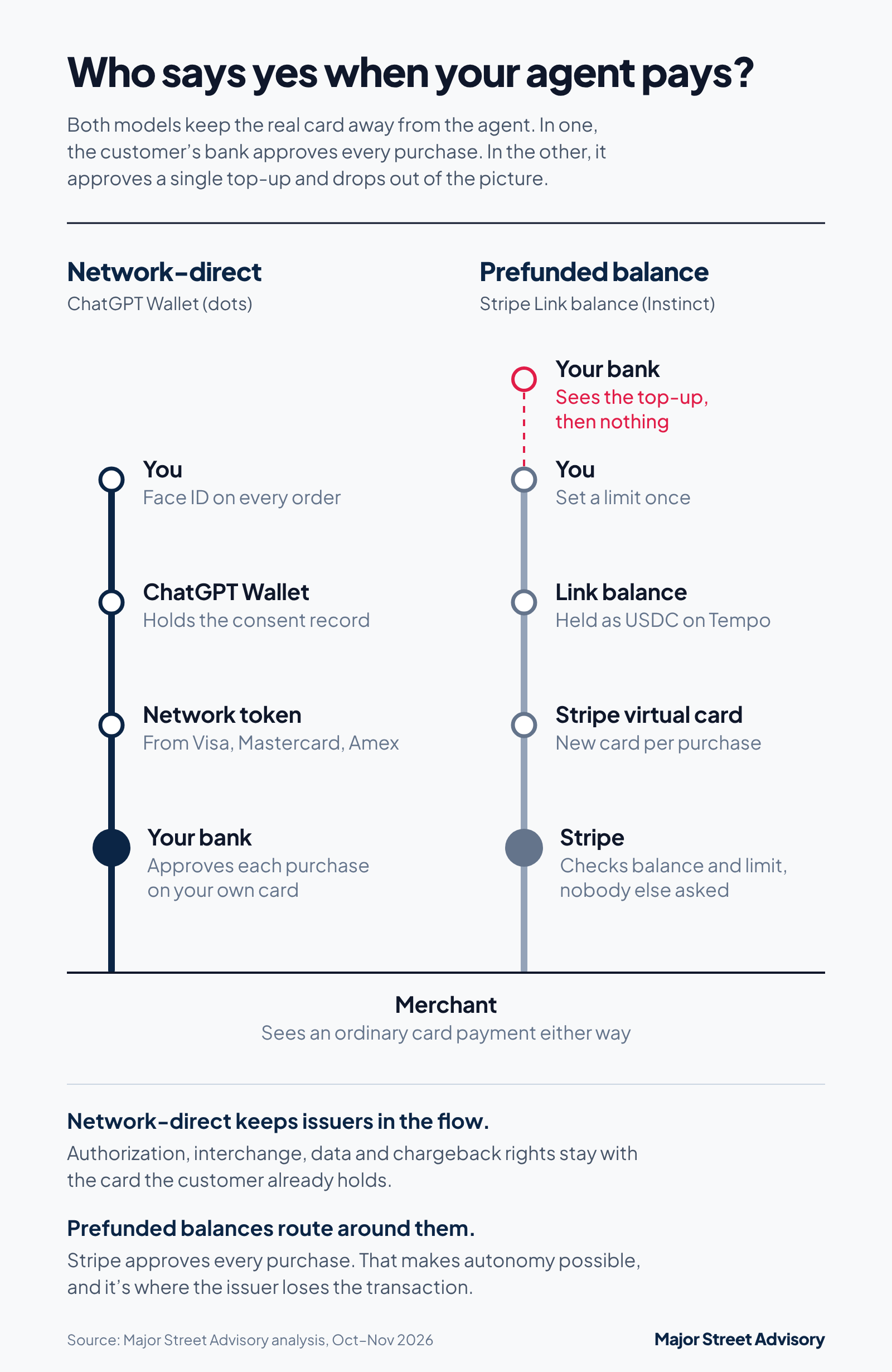
Two ways to let an agent pay
Muse and Instinct both run on Stripe’s Link wallet. When the agent buys something, Link issues a single-use virtual card capped at the amount the customer approved. Instinct goes a step further with Link balance: the customer tops up once, the money is held as USDC, and the agent spends from it within a per-purchase limit without asking each time.
ChatGPT Wallet takes the other route. OpenAI built it directly with Visa, Mastercard and American Express. The customer adds their own card once, approves each purchase with Face ID, and the network issues a token for that purchase. The charge lands on the customer’s card with their rewards and dispute rights intact. The easiest comparison is Apple Wallet, embedded inside ChatGPT.
The question that separates them is who says yes. In OpenAI’s model, it’s the customer’s bank, on every purchase. In Stripe’s prefunded model, it’s Stripe, checking a balance it already holds. The bank approves the top-up and then drops out of the picture.
Where it shows up on the P&L
Transaction data. This is the largest loss and the hardest to see. Merchant-level data feeds underwriting, fraud scoring, cash-flow insights and the offers inside a rewards program. When purchases sit behind a Stripe-issued card or a Link balance, the bank’s ledger often shows a payment to Link rather than the grocery store, the airline or the subscription. As agents take a larger share of a customer’s spend, every model built on that data gets a little weaker.
Interchange and rewards. In the network-direct model, an agent purchase is an ordinary transaction on the issuer’s card, so revenue and rewards economics carry over. In the prefunded model, the issuer earns on the top-up at most. The purchases themselves run on Stripe’s card program.
Deposits. A prefunded balance is money that has left the institution. A few hundred dollars per customer doesn’t matter. Millions of customers keeping a standing balance with their agent, the way many already do with PayPal, is a slow deposit outflow, and for credit unions that fund lending from deposits, it compounds.
Fraud and disputes. The network-direct model has its own cost. When a customer says “my agent bought that, not me,” the issuer is the first stop for the chargeback, while the best record of what the customer approved sits with OpenAI. Issuers keep the transaction but take on a new kind of dispute, with no settled rules yet on who bears the loss.
| P&L line | Network-direct (ChatGPT Wallet) | Prefunded balance (Link) |
|---|---|---|
| Interchange and rewards | Retained on every purchase | Top-up only, at most |
| Merchant-level data | Retained | Largely lost |
| Deposits | Unchanged | Balances move out |
| Fraud and disputes | New agent disputes land with the issuer | Shifted to Stripe’s protections |
Why OpenAI went this way
Working through the networks reads as an olive branch to large financial institutions, compared with intermediaries that are steadily collecting more consumer payment data. That matters because access is becoming the constraint. Amazon has already blocked Muse from its store, and banks are weighing whether to decline agent transactions on fraud grounds. With almost no switching costs between consumer agents, the agent that can actually complete a purchase at the most places has an advantage.
It also leaves OpenAI room to monetize later. It says it isn’t taking a commission “for now.” Apple Pay set the precedent: issuers kept the transaction, but they pay Apple for the privilege.
The trap in blocking agents
Declining agent transactions feels like prudent risk management. In practice, it doesn’t stop agent spending. A customer whose card won’t work with their agent can fund a Link balance in a minute, which moves them into the model that removes the bank from the transaction entirely. Blocking protects the institution from one risk by handing the customer relationship to the intermediary.
Where banks and credit unions can win
Be the easiest card to give an agent. Work with your processor and networks to support agent tokens, recognize agent-initiated transactions, and score them on their own terms rather than declining them as anomalies. Top-of-wallet now includes the agent’s wallet.
Own the controls. Apple Pay took the checkout screen, but banks kept token management in their own apps. The same opening exists here: per-agent spending limits, merchant restrictions, a pause button, and a clear view of which agents hold a customer’s card. None of the agent platforms has claimed this layer yet, and customers already trust their bank with the money involved.
Treat consumer-driven banking as the consent layer. Canada’s framework is mostly discussed as a competitive threat. The same consent infrastructure could let customers set an agent’s guardrails once, at their bank, and have them honoured wherever the agent shops. That makes the institution the place where agent permission lives.
Decide where you stand on your own agent. Verticalized financial agents are arriving, including Revolut’s Air inside its own app. Not every institution needs to build one, and many shouldn’t. But each should decide deliberately whether to build, partner, or be the trusted rail underneath someone else’s agent.
ChatGPT Wallet is US-only and limited to Pro subscribers today, and Stripe’s agent wallet already supports Canadian consumers. Canadian institutions have a short window to decide which of these models they want their customers using. The ones that keep the decisioning, the data and the consent inside their own walls will be in the strongest position as the competition for the customer relationship moves to agents.